The Neutral Zone Is Not Wasted Time

Gen X came of age believing adults kept it moving. You got an education, found a job, paid your bills and handled whatever life placed in front of you.
If work became exhausting, you pushed through. Complaining and whining didn’t change or solve anything.
That approach carried many of us a long way. Some made their way to the very top of their professions. It also helped us survive recessions, layoffs, family responsibilities and workplaces that changed faster than anyone could logically explain.
Then midlife arrived and exposed the limits of pushing through no matter what.
A job ends. Burnout turns into out of control anxiety. A role that once gave our days shape starts feeling too small or too heavy or simply finished.
Our first instinct is generally to replace what disappeared.
Find a new job. Then find a second one if necessary. Build another plan. Get busy. Movement often feels like proof that we’re still in control.
Yet rushing ahead can lead us straight back to the life that already stopped working.
We Were Taught to Keep Moving
Most of us were taught to take the hit, make an adjustment and keep going. For Gen X, toughness still matters.
It can also become a trap. We get so skilled at functioning that we miss the moment when endurance turns into avoidance and those difficult feelings force their way out in a manner that silences rooms.
We remain loyal, too loyal to old definitions of success because they once gave us stability, status and a way to provide for our families. Competence complicates the choice.
When you have spent 20, 25, or 30 years becoming good at something, walking away feels like turning your back on what you have been most of your life. Family and friends remind you how much experience you have.
Even your LinkedIn profile, you know that place you visit again and again reminds you how much experience you have. Nobody can see that the expertise they admire may be tied to a life you no longer want.
Is it outrageous to believe that you might seek to pursue more than one dream in a lifetime?
In “Transitions: Making Sense of Life’s Changes,” William Bridges writes: “Every transition begins with an ending.” A change is the visible event. While a transition is the internal work of accepting what the event altered in your life.
A layoff can end employment in one day.
It doesn’t end the identity built over years of meetings, deadlines, projects, promotions, and professional wins and losses. The paycheck is gone, but let someone, anyone stop you for one moment to ask you, “What do you do?”
Just like that, you’re speaking that job title and standing taller. So deep down inside, there’s a hidden belief that your value depends on staying in the same kind of work.
If you skip the ending Bridges talks about, the next opportunity may become a better-dressed version of the old one. New company. New manager. Same exhaustion. Same questions in your head about how long you can keep doing this.

You Know What's Wrong. You Don't Know What's Next
Bridges calls the time between an ending and a new beginning the neutral zone. The old identity has loosened its grip on you, but the new one hasn’t taken shape. You know what no longer feels right. But you cannot speak to what should replace it yet.
That uncertainty is uncomfortable for anyone, and especially brutal for Gen X. A quiet month can feel like falling behind.
Career questions also touch pride. Many of us became the dependable one in our families. We solved problems, ours and others, covered expenses, and kept our fears out of sight.
Admitting that the work we once loved no longer fits can sound like ingratitude. It can egg on words like “look at the Big Man” from family and friends. So, we run a couple Jedi mind tricks on ourselves.
I know this firsthand. After two decades in marketing and a layoff, I kept looking toward familiar roles that offered something unfamiliar to make them seem just like the right new direction. I even added credentials that would make me more attractive to employers in different sectors seeking the skills I possessed.
On paper, the moves made perfect sense. Only one problem persisted. Part of me deeply wanted to transition out of corporate to mission-driven work.
The other part of me wants to pursue writing. There’s an unplanted tree in the back of my mind. My dream was to become a writer, journalist, and intellectual.
Though there’s no chance in this world that I will ever match his brilliance, when I see Ta-Nehisi Coates, I think that’s the life that I wanted after college.
The neutral zone gave me the time and enough internal conflict to bring my dreams back.
Stillness Is Not Surrender
The neutral zone doesn’t require you to sit endlessly in reflection awaiting revelation. It asks you to stop filling every open space with the old answer. There is work to do. Much of it will not look impressive from the outside.
You start paying attention. What energizes you now? Which ambitions belong to you and which ones did you inherit from family, employers, or a culture that uplifts money as the only valuable proof of success? What are you doing right now with your free time because it matters to you?
This isn’t an argument to blow up your life. Midlife comes with real obligations. Mortgages are due. Health insurance matters. Children need support.
Your second act can begin quietly. Take the class. Start the side project. Have a conversation with someone doing work that stirs you up. Give a few hours each week to the idea that you kept pushing off.
Small experiment provide evidence. They help you separate a genuine new direction from the fantasy that change for the sake of change is good.
Beginning Without a Guarantee
Before a bad week becomes a bad year. Before work that once challenged you begins to empty you. Before the future you planned starts looking more like a jail sentence than a reward. Stop and exhale.
The first honest step may be a simple admission: This job no longer fits me.
You do not have to resign tomorrow, announce a new identity or explain yourself to everyone in your life. You do need to stop pretending the old arrangement can be restored through more effort.
You do need to stop kicking the can down the road.
I do not know where writing will take me. That uncertainty used to feel like evidence that the path wasn’t real. I see it differently now. A beginning does not need to arrive with a guaranteed outcome. It only needs to arrive with enough promise to take the next step.
The neutral zone gives an ending time to become real.
Stay there long enough to hear what constant motion covered up. Then ask the question many of us spend years avoiding: What is it time for you to let go of?
© Ink & Audible
I am part of the affiliate program with Bookshop.org. If you decide this book is a must read for you, the link below will allow you to purchase Transitions: Making Sense of Life’s Changes. I may earn a commission at no extra cost to you.
 William Bridges and Susan Bridges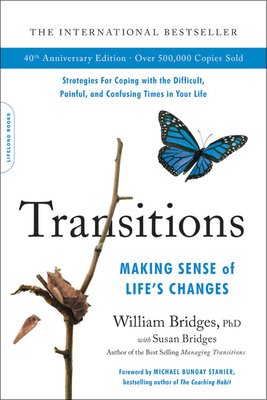




Member discussion