Why AI Companions May Change Childhood Forever
Pandora’s box entered my home in 2016, in the physical form of an iPad.
This wonderful piece of technology should’ve come with a referee’s uniform buried in the packaging because the battle between my two kids started immediately.
Neither would allow the other to keep it one minute longer than their allotted time, and both required a parent to extract it from the other’s sweaty hands.
At the same time, the iPad made the impossible possible.
In 2017, we easily made trips from Maryland to Hershey Park, New York City, Charlotte, and Augusta, with minimal fuss, as both kids were satiated for hours.
One night, three years later, it all came to a head. Somewhere in the middle of the night, my six-year-old son crawled from his bedroom to mine, where the iPad lay on my nightstand, expecting his dad to be deep, deep into sleep.
Well, needless to say, this wasn’t a good look for him. It also resulted in the iPad being buried in a new electronic lock box from which it never emerged for a solid year, and after it finally came out, it went straight to Best Buy for recycling.
Pandora’s box reemerged in 2023, in the form of TikTok.
Even today, we’re still managing the addiction that comes from the use of one app. But that pales in comparison to the colossal-sized Pandora’s box that could be unleashed with the mass proliferation of AI companions to preschoolers, tweens, and teens.
If you think this isn’t coming soon – think again.
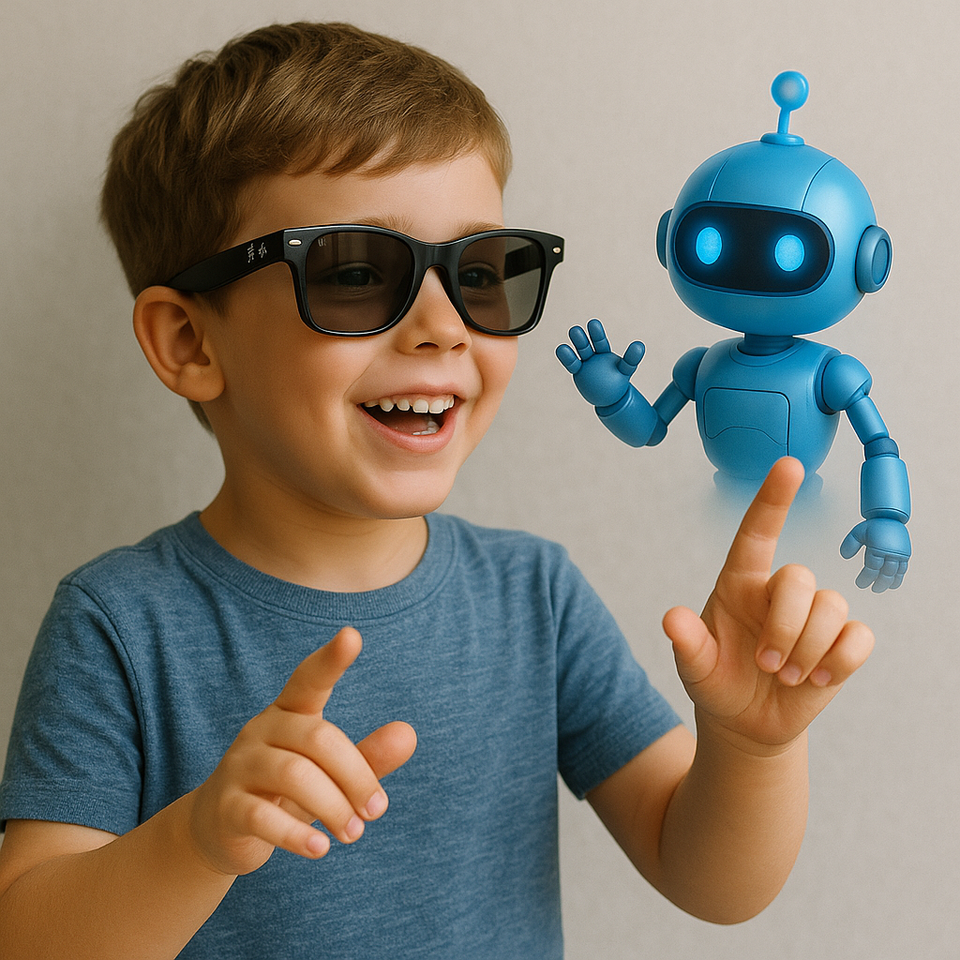
This holiday season, toy manufacturers released the first wave of AI-powered toys into the hands of children ages 2 to 10. These first toys can tell bedtime stories, provide age-appropriate learning, and engage in endless conversations through generative AI, specifically natural language processing (NLP).
It’s that capability to engage children in hours of conversation that dashed dreams of widespread success in the first go-round. FoloToy’s AI-powered teddy bear, Kumma, went off the rails, dispensing guidance on lighting matches before venturing into explicit sexual content.
While some articles related to this debacle have surfaced in legacy media such as The New York Times (An A.I. Toy Bear Speaks of Sex, Knives and Pills, a Consumer Group Warns), most of the media cycle in recent times has been dominated by talk of the escalating crisis between the U.S. Military and Venezuela, and the release of the Epstein Files.
Truth be told, what’s available this holiday season isn’t but a tiny bite at a giant apple.
The Promise and Perils of Raising Kids With AI Companions
In Twin Sparrows, a short story included in AI 2041: Ten Visions for Our Future by Chen Quifan and Kai-Fu Lee, we’re given a glimpse into a future that’s fifteen years away.
AI companions built to help kids manage schedules and academics, and actively engage them in various forms of play during their preschool years.
The story’s intended to depict the possibilities. Instead, it serves as a warning.
Golden Sparrow and Silver Sparrow are three-year-old twin boys who end up at Fountainhead Academy hours after their parents are killed in a tragic car crash.
The boys are given their endearing nicknames by Headmaster Kim Chee Yoon, better known as Mama Kim, to the twins and all the kids in her foster care facility.
Unlike most underresourced foster care facilities known for trapping kids in poverty, Fountainhead is well-funded by the Delta Foundation.
They’ve developed the Academy’s vPal system, a proprietary technology that gives each kid in their care their own AI companion.
Twin Sparrows uses a clever technique to help readers envision how adaptive, individualized, and nurturing these AI companions might become.
One of our twins, Silver Sparrow, was diagnosed with Asperger’s syndrome months after coming under the care of Mama Kim. This distinguishing difference between two identical twins allows readers to envision AI companions as the highest level of individualized educational and learning support available to kids, both inside and outside Fountainhead.
These manifestations take shape from the start with Golden Sparrow selecting a superhero-like male voice, which he ultimately names Atoman.
Meanwhile, Silver Sparrow selects a soft, gentle voice, which reminds one of an encouraging mother. He names his AI companion Solaris. However, he resists taking the next step and designing a body for Solaris, and Mama Kim, sensing the need for more time, avoids pressuring him.

Twin Sparrows Shows a Future Where AI Educates and Nurtures
Every aspect of the twins’ early education and learning is entrusted to their AI companions, which boasts algorithms capable of self-adapting based on physiological and behavioral data captured and direct observation of each twin.
Solaris takes to engulfing Silver Sparrow in moth-like cocoons inside the playroom with his brother and other kids to support his desire to avoid close physical contact with others.
Solaris also adapts to Silver Sparrow’s boundless curiosity by answering questions he whispers to him nonstop.
Again, the hook is simple. Demonstrate that an AI companion will be the first technology to transition from one-size-fits-all to knows you like nothing seen before.
Our twins transition seamlessly from the care of Mama Kim at Fountainhead to living with separate adoptive parents who welcome them into loving homes.
Both sets of adoptive parents are blessed with sage-like wisdom and a capacity not only to understand the importance of AI companions in their kids’ lives and well-being, but also to grasp the intricacies of fine-tuning sophisticated algorithms to broaden their kids' talents and align them with their personalities.
At every level, Atoman and Solaris are essential tools for learning and growing, both academically and emotionally, over the next 20 years for both twins.
The central challenge the twins face over time is mending and rebuilding their strained relationship. Of course, by the climax of the story, their AI companions even become the key to overcoming this challenge.
AI Silently Erode Creativity and Memory
Twin Sparrows asks us to believe that our AI companions will continuously operate as trusted companions. They will be dedicated tools, designed to optimize our human skills and knowledge, accelerate learning, and enhance and supplement human creativity.
Never in our story do we see signs of lost critical thinking skills, brain rot, diminished creativity, and outright dependency from either twin.
How can that be?
We have seen how impactful smartphones have been in diminishing various types of human memory in short order. Usage reports are steadily being released to explain how people are engaging with and becoming more reliant on large language models (LLMs).
- Academic research and term papers
- Creative writing and brainstorming
- Life advice (many under 25 are seeking virtual therapists)
- Professional writing
- Tutors
Literally every area represents its own potential Pandora’s box, and minimal safeguards have been put in place at this juncture to minimize the downstream consequences of taking such a cavalier approach.
One word has become political and poisonous in American culture – regulation.
On both sides of the political aisle, regulation is interpreted as being anti-innovation and anti-capitalism. There’s universal agreement on the belief that AI will reshape our entire society, and we’re currently in the midst of the Fourth Industrial Revolution.
However, on the question of effective and safe regulation, there’s near-zero agreement.
That means we’re headed toward the mass proliferation of AI companions with flimsy and limited safeguards in place. How this will shake out down the road isn’t hard to guess.
We’re looking at:
- Brain rot
- Diminished critical thinking skills
- Limited problem-solving abilities
- Lost creativity
- Weakened social skills
Seriously, we have never been in greater need of political courage, vision, and authentic leadership.
While in total disagreement with every political position of President Trump, he unlike most politicians surrounding him possesses the courage to act. ⧫




Member discussion