
AI 2041: Ten Visions for Our Future

One of the two countries most responsible for the creation, incubation, and rapid growth of artificial intelligence (AI) will become a casualty of its own creation by the year 2100.
Why?
Because controlling and neutralizing social unrest, political chaos, and economic upheaval, which will be fast-tracked by this technology from 2041 and beyond, will be impossible.
How exactly have I come to such a dramatic conclusion?
These thoughts crystallized after reading AI 2041: Ten Visions for Our Future, a thought-provoking collection of ten stories from Chen Quifan and Kai-Fu Lee.
Quifan is a well-known speculative fiction writer living in Beijing and Shanghai, China. Lee, the former head of Google China, brings his forty-year history working at the forefront of AI to analyze each of these stories and provide context with less of an agenda.
Given both authors are Chinese and live in China, you’d expect half of the ten stories to unfold in their country. Perhaps, they’d set the other half of the stories in America. They avoid that trap.
Quifan wisely selects settings around the globe. We’re in Sri Lanka, Nigeria, Mumbai, and Australia, to name a few places. There’s also a story set in Shanghai, and two are set in America.
40,000 Lives Saved....and Millions of Livelihoods Lost
Maybe it’s because I tend to enjoy healthy doses of reality and even melancholy endings with an “oh shit” twist in speculative fiction. However, there seems to be an effort on the part of Quifan to find, then present a happy ending with most of these stories.
So I guess it’s my job to take us down into the muck and mire.
“The Holy Driver,” set in Sri Lanka, depicts a world in which autonomous vehicles (AVs) have displaced human drivers. Chamal, our 13-year-old hero, is brought into a secretive project by his uncle due to his otherworldly skills with virtual reality (VR) racing games.
With the hope that his skills will translate to AI-based simulations capable of blending the real world and the simulations to achieve success with missions still requiring humans.
This story glosses over hard realities with a few paragraphs. Chamal’s father lost his job as a delivery driver to AVs.
His uncle has been relegated to working as a part-time guide, driving tourists as his sole source of income after being injured performing the same job he’s now recruited Chamal to do.
Chamal’s family is literally counting on him, a young boy with unique talents, to earn money to help pay for middle school tuition before the school year begins.
Today, we’re told and sold in this story, as well as in the world, about the promises of greater safety courtesy of AVs. Again and again, we’re asked to envision a future in which low-cost rides to anywhere we want to go are available through AVs.
Based on recent data from the National Highway Traffic Safety Administration (NHTSA) and the National Safety Council (NSC), around 40,000 Americans die annually as a result of vehicle crashes.
A tragedy for sure. Yet, the toughest questions are being ignored.
If self-driving cars, trucks, and buses lead to a world where those who have created livelihoods by driving and supported their families disappear – currently estimated to be around 4 million Americans, have we really made the best decision?
The 4 million doesn’t even include the growing number of Americans and others around the world who earn money as Uber/Lyft drivers in the gig economy.
Everything happening in our world technologically, especially AI-related, is calling on humanity to decide what they want socially, politically, and economically for all.
It’s also asking us to reassess and reinvent institutions built over the last 100 years.
We’re going to need to take the steps necessary to do that, understanding that those areas are where humans have control, at least for now.
Otherwise, our futures will be dictated to us once AI has grown beyond our control and takes the data fed to it by us, and makes final decisions for us.
The Long Road From Radical Idea to National Reality
One of two stories set in America, “The Job Savior” asks readers to suspend reality around our current political gridlock and chaos to imagine that three branches of government working together have previously passed legislation for universal basic income (UBI), and now debate rages over repealing it, because formerly employed workers are sinking deeper into depression, substance abuse, and suicide.
Their lives lack meaning in this world, as they once derived their human value from performing meaningful work.
Quifan and Lee are each clearly too distanced from today’s realities as employees to know that many of America’s workers are sinking deeper into anxiety, depression, and substance abuse as a result of their meaningful jobs.
The story tells us, on the heels of abolishing UBI in 2032, legislation emerges to create a new industry for job reallocation. The goal is quick assessments of the skill levels of displaced workers, job shifts for those readily capable, and job training and future placement for those being upskilled.
Though it's easy to dismiss the notion of this becoming reality, I think there’s a better than 50 percent chance of this happening. It’s the States which will lead the charge.
I’d anticipate something taking shape by 2035.
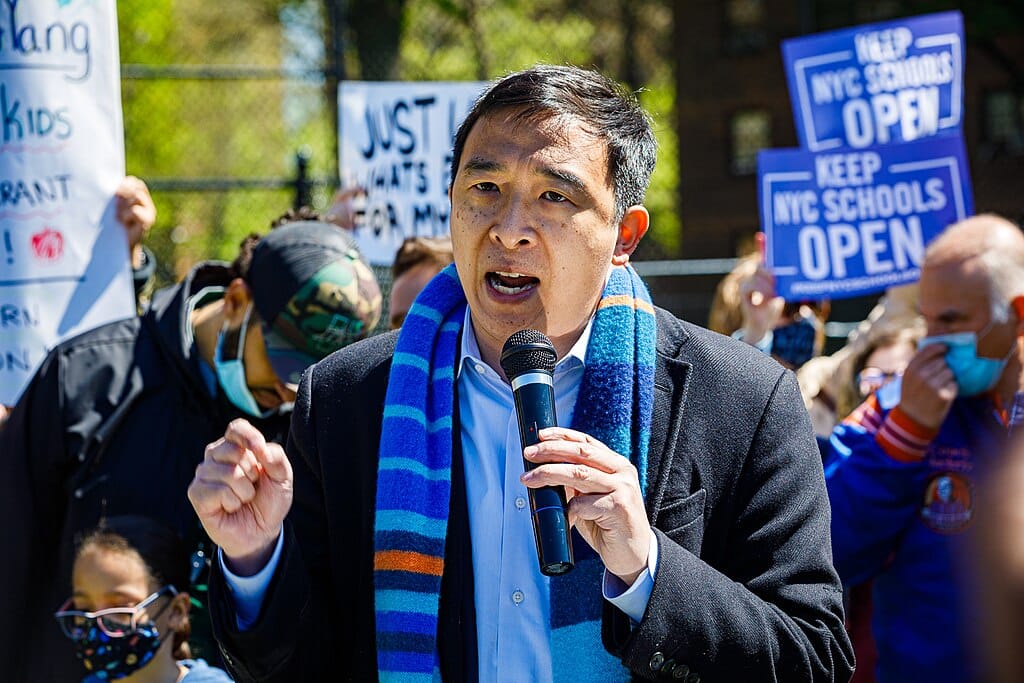
Go back to the 2020 Presidential election. Do you remember Andrew Yang?
He was the first political figure I can recall who publicly mentioned and promoted UBI. Yang comes from the technology sector, and the concept has been discussed within those circles for at least ten to twenty years before he made it the basis of his campaign.
Yang disappeared from the public eye after his failed Presidential run and resurfaced in mid-2021 with a bid to run for Mayor of New York. His platform again UBI.
That also failed. Since he has left the public stage. So has talk of UBI.
But, can we go even further back in American history? President Franklin Delano Roosevelt (FDR) signed the Social Security Act into law in 1935. You may not know that discussions about the need for social insurance date back to the 1910s.
Twenty-plus years were needed to build up the momentum and political will to turn it into reality. Maybe, once mass-scale joblessness becomes real and social unrest starts to show signs of escalating into a revolution, the political will grows strong enough to make UBI something Americans actually receive by 2041.
A World Without Money: That Still Practices Bias and Injustice
The last story in the collection, “Dreaming of Plentitude,” takes readers to Australia in 2041, in a post-scarcity society. What exactly does that mean?
Well, it’s the belief that the very goods and services we strive and strain to pay for now will be available in abundance for little to no cost, and humans won’t have to spend all their lives first attaining the education needed to get ahead and then working 50 to 60-plus-hour weeks to have a prosperous life.
You'll no longer need to do anything like that.
Our protagonist, Keira, a young aborigine woman, steps into the home of Joanna Campbell to open the story. Campbell is a 71-year-old famed marine biologist who is living in a smart retirement community located in Brisbane, and she’s exhibited enough signs of early-stage Alzheimer’s disease as diagnosed by her smart home to merit the need for constant help.
We’re introduced to Moola, a government-sponsored form of virtual currency designed to replace money, which isn’t relevant in a post-scarcity society.
Moola operates like money by incentivising specific types of behavior, and it is used to cover the cost of food, shelter, utilities, transportation, and everything else.
Quifan’s story and the post-story analysis from Lee serve to illuminate that the daily experiences of those at the lower rungs of society will remain the same, whether living in a post-scarcity society or a scarcity society.
You will continue to deal with bias, social injustice, social classes, and unemployment.
Isn’t technology supposed to be ushering us into a world where working is optional, and we have an abundance of free time to dedicate to other life pursuits?
Strangely, it’s their vision of how post-scarcity could work in a country outside America that makes continuing to live in a society based on scarcity less scary.
While the possibility of a post-scarcity society looms, let’s not be mistaken: this isn’t happening by 2041.
There are undoubtedly countries where renewable energy represents the most positive change that country could ever experience. Half of the world has seen its economic prospects dimmed by energy insecurity and constraints.
Many will have an opportunity to build the renewable energy infrastructure needed to thrive later in this century.
Within America, the entrenched players who are the country's unseen rulers will never make room for a post-scarcity society.
Capitalism has always been a game of winners and losers.
America was founded on two core principles: capitalism and democracy. While one is bending, even yielding to authoritarianism.
America will never abandon capitalism.
Maybe, it's appropriate to ask, "Can capitalism be reinvented?" It would take the reinvention of capitalism to allow for the transformation to a post-scarcity society.
Worth the Read
My words probably make it seem like I didn’t enjoy the book. I did. Honestly, what you felt was my need to punch back at the overtly optimistic tone of the book.
Quifan and Lee have delivered a format and approach to speculative fiction that nicely meshes the real and imagined. We need more books like this.
Millions, and I mean millions, inside and outside of America can’t conceptualize what is truly happening in this fourth industrial revolution.
While reading AI 2041: Ten Visions for Our Future introduces a range of possibilities, some will become reality shortly.
We’re already seeing insurance programs built similar to the first story, “The Golden Elephant,” and I absolutely expect the marriage of the internet of things (IoT) to surface in full force as insurers shift from coaxing to demanding that we control our behaviors to keep insurance premiums low.
Buy it, read it, and learn more from it. ■
I am part of the affiliate program with Bookshop.org. If you decide this book is a must read for you, the link below will allow you to purchase AI 2041: Ten Visions for Our Future. I may earn a commission at no extra cost to you.
 Crown Currency




Member discussion